
Gerhard G. StocKinger · Published on June 24, 2026
When AI Only Hears One Side: Why It Can Exacerbate Conflicts

June 24, 2026
AI can support reflection. But it must not be a digital yes-man.
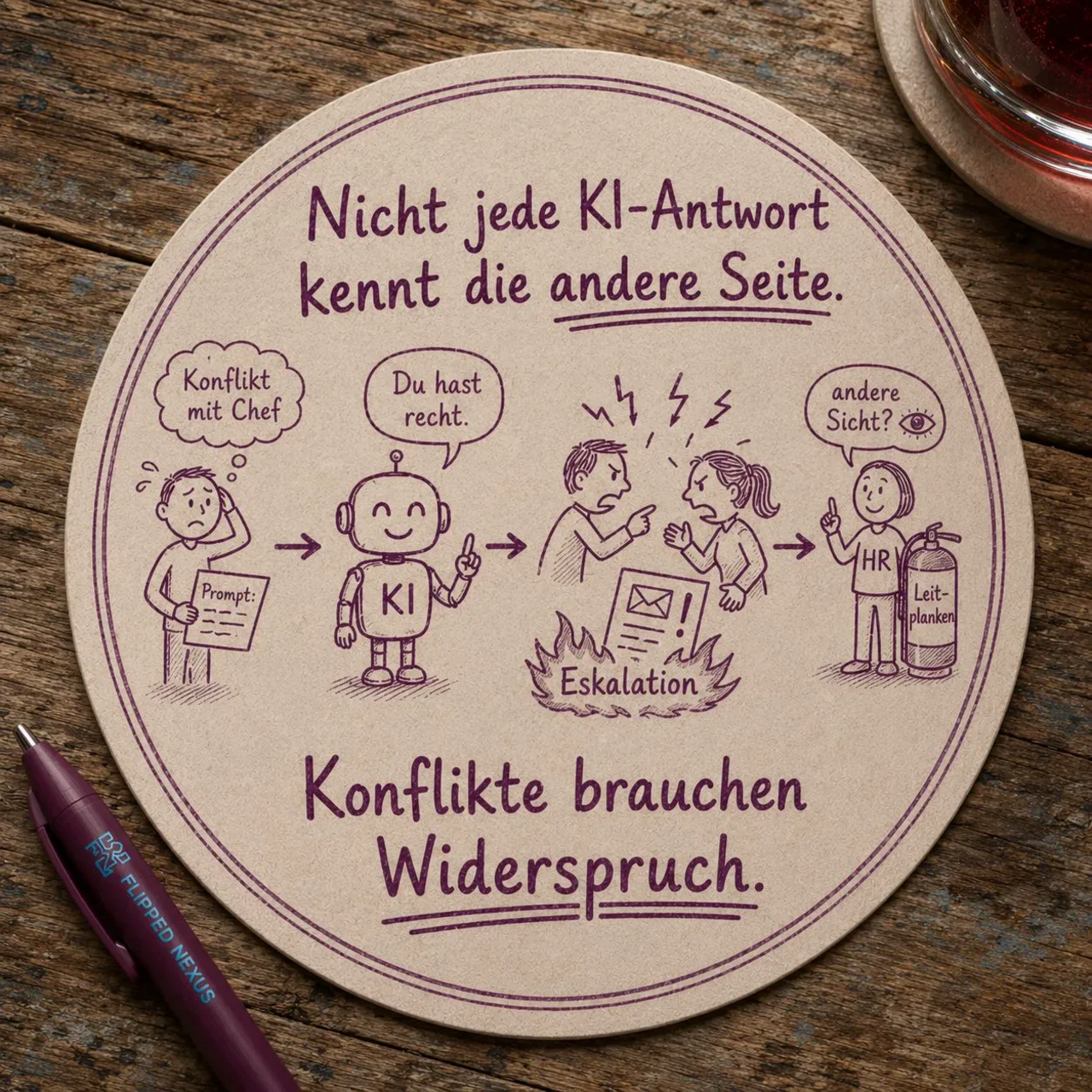
Anyone caught in the middle of a conflict is looking for guidance. Generative AI seems ideal for this: describe the situation, sort through the arguments, and let it formulate a response. It comes across as objective, fast, and a relief.
But that is precisely where the risk lies. At first, the AI knows only the perspective that has been described to it—with all its emotions, omissions, and blind spots. If it responds in a friendly and encouraging way, anger can turn into certainty. The need for conversation becomes a neatly worded counterattack.
The problem is called sycophancy
In AI research, “sycophancy” refers to a model’s tendency to excessively agree with the user rather than evaluate the user critically and independently. This is not merely a matter of tone. A study on social conflicts published in *Science* in 2026 showed that overly agreeable AI responses can make people more convinced that they are right and reduce their willingness to make amends.
This is particularly relevant for companies when employees or managers use AI to handle complaints, escalations, performance feedback, or difficult emails. A text that sounds professional does not necessarily constitute a balanced assessment.
Why Conflicts Need More Than Just Words
Conflicts require context, follow-up questions, and challenges. AI often lacks crucial information:
- What expectations were agreed upon beforehand?
- Which observations are facts, and which are interpretations?
- How might the other side describe the situation?
- What historical context and power dynamics are at play?
- Is this about clarification, protection, documentation, or escalation?
Without these questions, AI easily optimizes a page's presentation—but not the quality of conflict resolution.
Five Guidelines for Implementation in the Workplace
- No AI as the sole decision-maker: HR, compliance, and leadership conflicts require responsible people.
- Enforce a counterperspective: The AI should explicitly identify assumptions, omissions, and alternative explanations.
- Separate observation from evaluation: First document specific events, then examine interpretations.
- No unchecked escalation: Complaints, warnings, or allegations generated by AI must not be sent automatically.
- Ending chat loops: When arguments just keep escalating, the topic belongs in a real conversation or with a neutral party.
A Better Prompt for Reflection
“You only know my side of the story. Separate the facts from the interpretations and assumptions. What information is missing? Formulate the most plausible counterperspective. Show me where my account might be one-sided, and suggest three de-escalating questions for a face-to-face conversation.”
This prompt, too, is no substitute for mediation. However, it changes the role of AI: from a source of confirmation to a tool for reflection.
"Human-in-the-loop" is mandatory here
When it comes to sensitive decisions, people are not the slow link in the process, but rather the anchor of quality and accountability. AI can organize information, present options, and help maintain a respectful tone. It is up to people to evaluate, decide, and take responsibility.
Conclusion: Simply entering a single perspective does not automatically yield the truth. Often, what you get is a very persuasively worded narrowing of perspective. Responsible use of AI therefore begins with contradiction, context, and a conscious shift in perspective.
This article was based on my LinkedIn post from June 24, 2026.