
Website Relaunch & AI
Website in Its Eighth Year: Thanks for the Kick in the Butt
Technically, our website was well-maintained. In terms of content, visuals, and user experience, it had reached its eighth year. A brutally honest persona report sparked a relaunch in which Radical Personas, ChatGPT, Codex, and human decision-making each played a distinct role.
Surprisingly, you almost never have time to market your own company.
Client projects take priority. Quotes need to be prepared, solutions designed, and new technologies tested. In the midst of all this, your own company often just gets left behind. You regularly resolve to revamp the website, post more frequently on the blog, and refine your positioning.
Then comes the day-to-day business.
And suddenly, a few more years have gone by.
Technologically up-to-date, but outdated in terms of content
StocKinger Consulting GmbH is now in its eighth year. I realized just how quickly time has passed, not least because of our website. After all, it, too, dates back largely to the company’s early days.
Of course, the technical side of things was kept up to date. TYPO3 was updated regularly—at the latest when the end of support for a version was approaching. Security updates, system upgrades, and necessary adjustments were carried out.
But technical maintenance is not the same as further development.
Over the years, there have been far fewer changes to the user experience, the presentation of our services, the visual design, and our content strategy. The blog also fell further and further behind. Much of the content that would have appeared as blog posts in the past, I instead published directly on LinkedIn.
From a reach perspective, that was certainly a success. For our own website, however, it meant a standstill.
Then came Radical Personas
The other day, a colleague showed me his new product: Radical Personas. What could be more natural than testing the system right away on my own website?
Radical Personas positions itself as a tool for early-stage marketing, UX, and product feedback. Content is evaluated from the perspective of synthetic personas. The results include scores, justifications, comments, and a PDF report, among other things.
Instead of just getting a general AI response to the question “What do you think of this website?”, you receive feedback from various professional, personal, and situational perspectives.
It’s important to put this into perspective: Synthetic personas can provide hypotheses, early feedback, and new perspectives. They complement real user research and customer interviews, but they do not replace them.
Failed with great fanfare
My website, now in its eighth year, failed the analysis with flying colors.
The criticism wasn't limited to the visual design. Among other things, the personas questioned the positioning, the clarity of the services, the reasoning, the user experience, and why a potential customer should choose us of all companies.
Some of the statements were exaggerated. Others were a little hurtful. And on a few points, my first instinct was to disagree.
After giving it a moment's thought, however, I realized that the virtual critics weren't entirely wrong.
While the website did showcase what we had accomplished in recent years, it didn’t adequately explain what StocKinger Consulting GmbH stands for today. Especially in the areas of AI, automation, and intelligent process solutions, our service portfolio had evolved much more rapidly than our website.
So the website wasn't bad. It just wasn't up to date enough anymore.
Still, just starting over from scratch would have been the wrong thing to do
Now, one could simply delete the old website and start from scratch. However, that would have been just as unwise.
The current website attracts a significant number of visitors every month. Some older blog posts, in particular, are regularly found via Google. Many of these posts answer very specific questions and have established strong rankings in search results over the years.
Simply removing this content would amount to the destruction of digital value.
Old doesn't automatically mean bad. A website is more than just its design. It has structures, URLs, search engine rankings, backlinks, and content that have evolved over the years. A visually impressive redesign can cause significant damage if these assets aren't taken into account.
The task, therefore, was not to “start from scratch,” but rather to “preserve what works and consistently update what no longer fits our current positioning.”
From a no-holds-barred report to concrete implementation
I then uploaded the Radical Personas report to ChatGPT and analyzed it. The points of criticism were organized, evaluated, and translated into specific actions:
- Which statements were actually relevant?
- Which points related solely to the design?
- Where was the substance or a clear line of reasoning lacking?
- Which existing content and URLs needed to be preserved?
- How should the new website be structured so that it better conveys what we do today?
Codex was then provided with a duplicate of the existing website. The task was clear: not to start from scratch, but to systematically further develop the existing TYPO3 system. Content, page structures, and search engine rankings were to be preserved as much as possible. At the same time, the design, navigation, text, and positioning had to be fundamentally modernized.
A critical persona report thus became a sort of specification document for the revision.
This process also demonstrates how quickly a well-prepared relaunch can be implemented today. The key to success was not rushing blindly ahead, but rather using a protected duplicate site, defining clear requirements, taking small, verifiable steps, and conducting ongoing tests of URLs, SEO, layout, and functionality.
What Has Changed Specifically
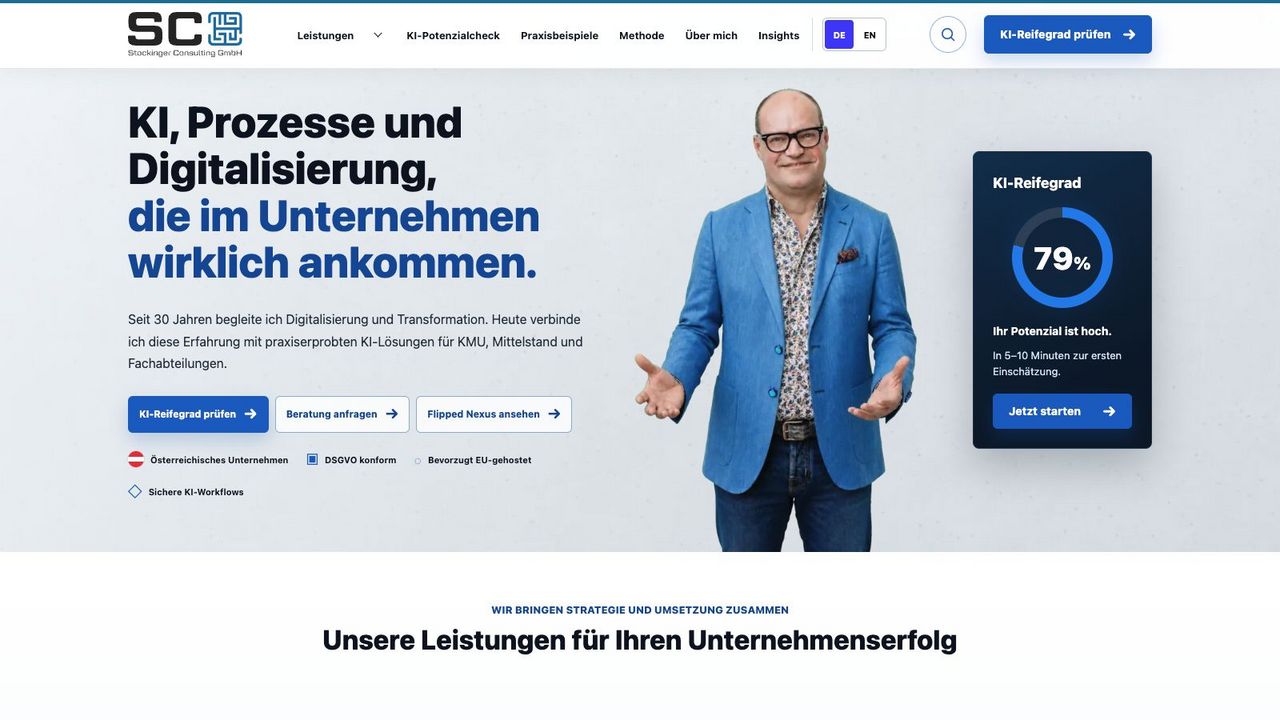
The result is now online at www.stockinger.gmbh. It's not just a website that has been given a new color scheme or larger headings.
The new website provides a much clearer overview of what we do today: AI sparring, intelligent automation, software review and documentation, workshops, keynote presentations, and the pragmatic digitization of business processes.
Visible and structural changes include, among other things:
- a clearer positioning right on the home page,
- simplified, responsive navigation,
- anonymized real-world examples with a clear description of the initial situation, approach, solution, and benefits,
- a revamped methods page focused on business enablement,
- an improved search function and an enhanced Insights archive,
- Public events and recordings in a dedicated media library,
- a mobile digital business card for QR codes at events,
- greater accessibility, better performance, and consistent design,
- as well as the deliberate preservation of important existing URLs and content.
Even older posts and historical URLs remained accessible. After all, a relaunch is only successful if it not only looks more modern but also preserves existing digital value.
Three AI tools—three different roles
This process demonstrates how AI tools can be effectively combined:
- Radical Personas provided critical perspectives and brought blind spots to light.
- ChatGPT helped structure the extensive report, prioritize feedback, and turn it into actionable work packages.
- Codex provided support with analysis, TYPO3 configuration, content management, design, migration, and technical testing.
People remained the ultimate authority in this process: Which criticisms are valid? Which approach best reflects the actual work? Which content must be preserved? Which changes are technically feasible, economically sound, and truly helpful to visitors?
What I've learned from the project
For me, the most important benefit of Radical Personas wasn't a single recommendation. It was the shift in perspective.
Anyone who has built a website themselves or maintained it for years is familiar with every phrase, every subpage, and every decision behind them. As a result, it’s easy to lose the perspective of a new visitor. You no longer read what’s actually on the page; you read what you intended to convey back then.
This is exactly where synthetic personas can provide valuable feedback. They are no substitute for real conversations with customers or real-world user testing. But they can quickly highlight inconsistencies, unclear messages, and blind spots. Above all, they ask the questions we tend to avoid asking ourselves.
Thanks for the much-needed kick
Marketing for our own company will likely continue to take a back seat to client projects in the future as well.
But sometimes it takes an outside push to turn “We should revise that at some point” into a concrete project.
With that in mind, a big thank you to the Radical Personas team for that good, hard kick in the butt.
It was necessary.
And, looking back, it was also quite effective.