
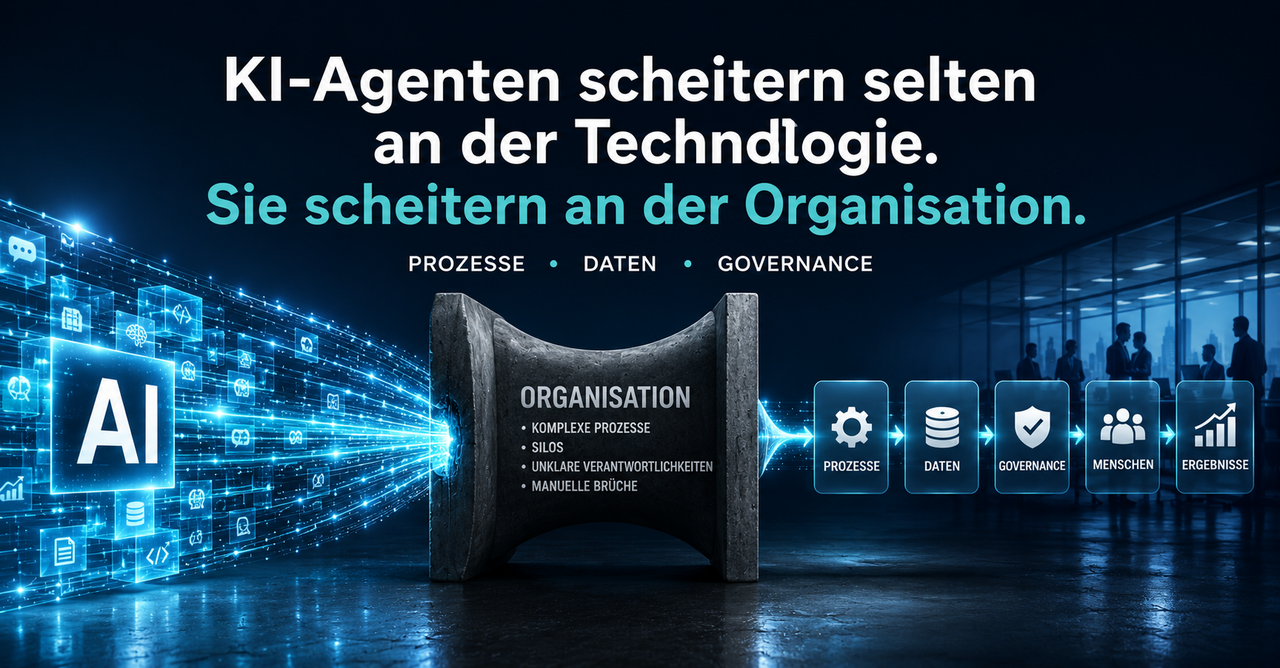
AI agents rarely fail because of the technology. They fail because of the organization.
Many companies have now completed their initial phase of experimentation with generative AI. ChatGPT, Copilot, in-house assistants, automation tools, and the first AI agents have found their way into many organizations.
So the big question is no longer:
Can AI help in general?
A better question would be:
Why is it that, despite the use of AI, there is often still no real scaling effect?
My clear opinion: Because many companies still treat AI as a tool rather than an integral part of the organization.
An AI agent is not just a better chatbot.
An AI agent is a digital actor in the process.
And it is precisely this difference that is crucial.
The Fallacy: Simply Applying AI to Existing Processes
Understandably, many companies take a pragmatic approach at first. A department selects a tool, tests a few prompts, automates individual tasks, and is pleased with the initial time savings.
That's a good start.
But it's not enough for scaling.
Because when AI is simply “slapped on top” of existing, historically established processes, the following often happens:
Inefficiency is accelerating.
Media breaks remain.
Responsibilities are becoming less clear.
Data quality suddenly becomes a bottleneck.
And in the end, management wonders why the promising pilot project never turns into a reliable production system.
AI doesn't automatically speed up good processes.
First and foremost, AI speeds up what already exists.
Chaos, too.
An agent needs more than just a good prompt
In public discourse, there is a lot of talk about models, prompts, and tools. That’s important, but it’s only part of the story.
An AI agent needs more than just language comprehension. It needs a clear organizational framework.
He needs a clearly defined task.
He needs access to relevant data.
He needs well-defined permissions.
He needs quality criteria.
He needs escalation rules.
He needs governance.
And he needs a process in which his role is clearly described.
Otherwise, you won't end up with a digital employee, but rather a digital random number generator with a Wi-Fi connection.
That sounds harsh, but in practice, that's often exactly the point.
In 2026, Process Expertise Will Determine AI Success
In my opinion, 2026 won't be the year when the best prompt wins.
This will be the year when companies that truly understand their processes come out on top.
Why?
Because AI agents excel in situations where processes are clearly structured. They can collect, verify, summarize, classify, prepare, trigger, and document information. But to do so, they need an environment where it is clear what “correct,” “complete,” and “approved” mean.
Here's an example from everyday business life:
A customer inquiry arrives via email.
An agent identifies the issue.
The agent checks the customer's master data in the CRM.
The agent verifies the contract information.
The agent drafts a response.
The agent suggests a task for the appropriate employee.
The agent documents the process.
Sounds easy.
But is that only the case if it has been clarified beforehand:
What data is the agent allowed to see?
What systems is the agent allowed to use?
Which responses is the agent allowed to prepare on their own?
When must a human review the response?
What is logged?
How is quality measured?
Who is responsible?
This is exactly where the playground ends and productive work begins.
AI is not just an IT project
One of the biggest mistakes in AI projects is the assumption that the topic belongs exclusively to the IT department.
Of course, technical expertise is required. Without interfaces, data models, access control schemes, logging, and security, it won't work.
But the greater leverage often lies elsewhere.
AI agents are changing the division of labor.
They are changing decision-making processes.
They are changing responsibilities.
They are changing the way knowledge is used within the company.
This means that AI is not just a technology project.
AI is organizational development.
AI is process management.
AI is change management.
AI is a leadership task.
And yes, that does make things more challenging.
But that is precisely where the economic benefit lies.
The Pragmatic Approach to Scaling
Companies don't have to come up with the perfect AI strategy for the next five years right away. In practice, a different approach usually works better.
You start with a specific, relevant process.
Not with “We need AI.”
But with: “This process takes time, leads to errors, or ties up skilled workers unnecessarily.”
The process is then analyzed:
Where do delays occur?
Where is information transferred manually?
Where is context missing?
Where are decisions made repeatedly following the same pattern?
Where do people need to review things but don’t necessarily have to handle everything themselves?
Only then will a decision be made regarding the role AI should play.
It could be an assistant.
It could be a classifier.
It could be a search agent.
It could be a verification agent.
It could be an orchestrator that triggers other systems.
The key point is this: AI plays a role in the process—it’s not just another item on the list of tools.
"Human-in-the-loop" is not a step backward
Some discussions about AI agents sound as if complete automation were always the goal.
I think that's a dangerously oversimplified view.
In many business processes, people are not the problem. People are the cornerstone of quality.
"Human-in-the-loop" does not mean that AI fails. It means that responsibility is deliberately structured.
An agent can prepare.
A person makes the decision.
An agent can review.
A person approves.
An agent can document.
A person evaluates exceptions.
Especially in regulated, sensitive, or customer-critical areas, this is not a hindrance but a mark of quality.
Respect for AI does not mean fear of AI.
Respect means using the technology professionally.
The real question isn't: Which model?
Of course, the choice of model matters. GPT, Mistral, Claude, local models, specialized models, routing through different providers—all of these have their place.
But in many projects, people start talking about models too early.
The more important questions are, first of all:
Which process do we want to improve?
What data is needed for this?
What risks arise?
What level of quality do we expect?
Which decisions should remain in human hands?
Which metrics indicate success?
How is operations monitored?
Only then does the question of which model is right come up.
Otherwise, people buy technology before they've clearly defined the problem.
It's kind of like ordering an excavator before you know whether you're going to build a house, dig up a garden, or just need a hole for a fence post.
Conclusion: AI success is a process
AI agents will transform many areas of business in the coming years. Not because they are magical, but because they combine language, context, data access, and options for action.
But that's exactly why they need structure.
Companies that view AI solely as a tool will achieve isolated efficiency gains.
Companies that view AI as an integral part of their processes and organization will achieve significantly more:
Faster decisions.
Better information flow.
Less manual routine work.
Higher process quality.
More time for real expert work.
My clear thesis:
AI agents rarely fail because of the technology. They fail because of unclear processes, poor data quality, and a lack of governance.
Or, to put it more positively:
Those who understand processes can scale AI.
And that's exactly where the real work begins.
Not at the prompt.
But during the process.
Gerhard G. StocKinger
StocKinger Consulting GmbH
Digital Transformation, Processes, and AI Solutions for Businesses