
Tag: AI Agents

KI richtig einsetzen: Auswahl, Sicherheit und Custom-GPT-Migration

Teil 3 liefert eine pragmatische Auswahlhilfe, behandelt Berechtigungen, Prompt Injection und Datenschutz und ordnet die Migration bestehender Custom GPTs ein.
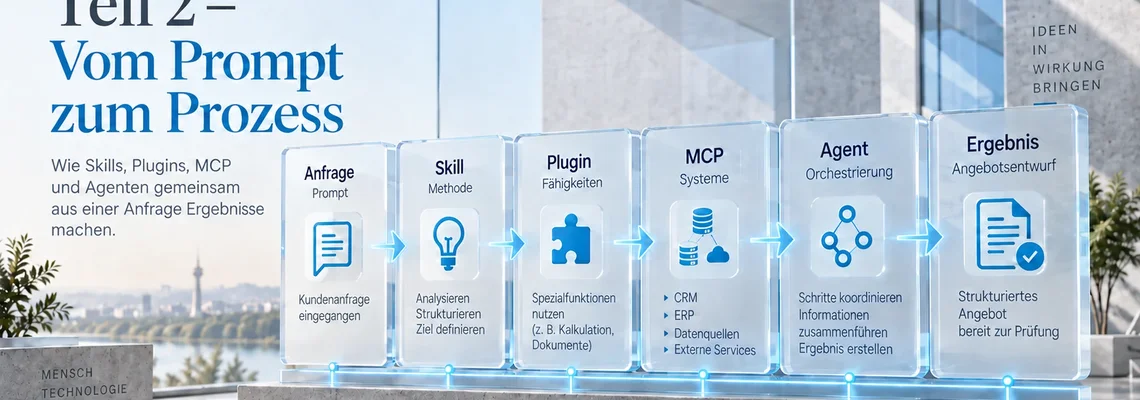
Vom Prompt zum Prozess: So arbeiten Skills, Plugins und KI-Agenten zusammen
Teil 2 zeigt anhand einer Angebotsvorbereitung, wie Skills, Plugins, MCP und KI-Agenten aus einer Anfrage einen kontrollierten Prozess machen.

ChatGPT Plugins, Skills, Agents und Custom GPTs: Was ist der Unterschied?
Skill, Plugin, Agent oder Custom GPT? Teil 1 der Serie erklärt die unterschiedlichen Rollen und zeigt, welcher Baustein welche Aufgabe übernimmt.

GibberLink: Sprechen KI-Agenten plötzlich ihre eigene Sprache?
Zwei KI-Agenten telefonieren und wechseln plötzlich zu Pieptönen. GibberLink ist keine geheime KI-Sprache, sondern ein experimenteller Wechsel auf einen vorgegebenen Data-over-Sound-Kanal.

GPT-5.6 Prompting: Why Fewer Instructions Often Have a Greater Impact
The new OpenAI guidance for GPT-5.6 emphasizes leaner prompts, clear success criteria, relevant tools, stop rules, and controlled migration rather than ever-longer sets of rules.

AI agents usually don't fail because of technical issues
Why AI agents fail due to unclear processes, poor data quality, and a lack of governance—and how companies can make the transition from pilot projects to full-scale deployment.

AI agents reduce switching costs

AI Automation Put to the Test: What the Remote Lab Index Reveals
Autonomous agents are impressive in demos, but they still often fail when faced with real-world, multi-step tasks. Companies need measurable tests instead of blanket promises of automation.

MCP and A2A: The Infrastructure for Networked AI Agents
MCP and A2A create open connections between models, tools, and agents. For companies, this means that not only the model but also the integration architecture becomes crucial.
